
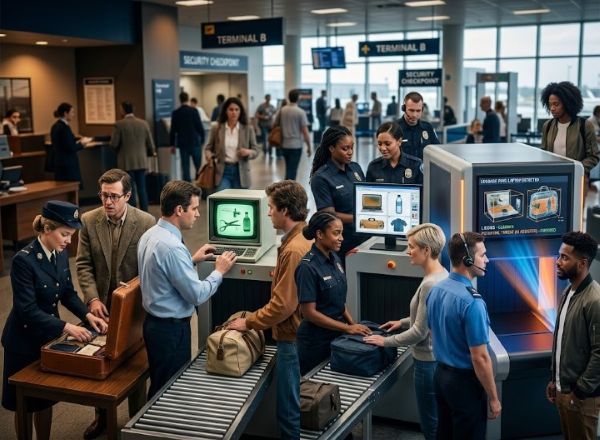
Baggage screening technology has changed dramatically over the years. What once relied entirely on manual inspection has now become a smart, technology-driven process powered by advanced X-ray imaging and artificial intelligence (AI). Companies such as Krystalvision Image Systems Pvt. Ltd. have witnessed this transformation firsthand, observing how security systems have evolved to meet growing safety demands across airports, railway stations, metro networks, and other high-security areas.
As global travel increased and security concerns grew, traditional screening methods were no longer sufficient. The need for faster, more accurate, and more reliable systems led to continuous innovation. Let’s explore this journey step by step.
The Time of Checking Bags by Hand
In the early days of air travel and public transportation, baggage screening was entirely manual. Security officers physically opened bags and inspected their contents one by one.
This approach was simple but heavily dependent on human attention and judgment. It was time-consuming, inconsistent, and not always effective. Different officers might interpret items differently, making it extremely difficult to detect cleverly concealed threats.
As passenger numbers increased, manual inspection became impractical. Long queues formed, delays became common, and the risk of human error remained high. It became clear that technology was necessary to improve both speed and reliability.
The Start of X-Ray Screening Systems
The first breakthrough in baggage screening came with the introduction of X-ray machines.
- Bags no longer need to be opened manually.
• Security officers could see inside luggage using X-ray images.
• Large volumes of baggage could be screened quickly.
• Suspicious shapes and dense objects became easier to identify.
Early X-ray systems produced basic black-and-white images. While this was a significant improvement, operators still required extensive training to interpret the images correctly. Human expertise remained crucial in identifying potential threats.
Progress with Dual Energy and Color Imaging
As security threats became more complex, screening technology continued to advance. Dual-energy X-ray systems were introduced to help differentiate between materials.
Instead of simple black-and-white images, newer machines displayed objects in different colors based on their composition. This allowed operators to distinguish more easily between metals, organic materials, and other substances.
This development reduced confusion, minimized unnecessary manual inspections, and improved detection accuracy. Screening became faster, smoother, and more dependable.
The Function of Computed Tomography (CT) Scanning
Another significant milestone in baggage screening was the adoption of CT scanning technology.
- Produces detailed 3D images of bag contents.
• Allows operators to rotate and examine objects from multiple angles.
• Improves detection of explosives and concealed threats.
• Reduces guesswork in image interpretation.
CT scanning provided security teams with far greater clarity and precision. It significantly reduced false alarms and enhanced confidence in the screening process, while also improving overall passenger flow.
X-Ray Systems with AI: The Present Day
Today, baggage screening has entered the era of artificial intelligence. Modern X-ray systems are equipped with AI algorithms trained to identify dangerous items automatically.
Rather than relying solely on human observation, AI highlights suspicious objects for operators. This partnership between technology and human expertise enhances both speed and accuracy.
AI-based systems continuously learn from new data, allowing them to improve detection performance over time. The result is stronger security without slowing down passenger movement.
Main Benefits of AI-Based Screening
- Automatic detection of weapons and explosives.
• Fewer false alarms and unnecessary bag checks.
• Faster baggage processing times.
• Continuous improvement through machine learning.
• Better decision support for security personnel.
These advantages make AI-enabled screening systems more efficient and reliable than traditional methods.
Looking Ahead
The growth of baggage screening technology demonstrates how innovation addresses real-world security challenges. From manual inspections to AI-driven imaging, each stage has focused on enhancing safety while improving efficiency.
Organizations such as Krystalvision Image Systems Pvt. Ltd. continue contributing to advancements in imaging and screening solutions. As technology advances, baggage screening systems are expected to become even smarter, faster, and more precise, ensuring secure transportation environments while maintaining a smooth experience for travellers.



Leave a Reply