
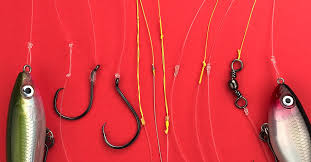
Fishing in saltwater presents a unique set of difficulties. Weak spots in your setup can be swiftly revealed by strong tides, sharp-toothed animals, abrasive structures, and forceful runs. Selecting dependable saltwater fishing rods and high-quality line is crucial, but how well everything works together is frequently the true test. Whether you land a trophy catch or let it swim away depends on how well you use your fishing knots.
Knowing a few tried-and-true saltwater fishing knots is crucial for fishermen going to the seaside. Because of their strength, ease of use, and dependability in challenging marine circumstances, these knots are trusted by seasoned fishermen throughout the United States.
Why Fishing Knots Matter in Saltwater
Saltwater is punishing on tackle. Lines abrade along rocky surfaces, docks and the reefs, also across fish’s sharp jaws. Add to this the strong current and lottery-like aggressiveness of some fish having sudden runs! We must ensure it best bears the consequences. Even the best saltwater fishing rods and reels cannot make up for weak, slippery knots.
A proper fishing knot is one that succeeds in securing the greatest tensile strengths, resisting abrasions, and holding even after many subsequent casts. Selecting the right kind of knot becomes crucial for situations helping anglers come unscathed out of the pit of gear-losing disasters.
The Improved Clinch Knot
The Improved Clinch Knot is still among the most popular fishing knots. Its plain design easily knotted to hooks, swivels, and lures onto monofilament or fluorocarbon.
This knot can be trusted inshore saltwater fishing for species like snapper, trout, or flounder. It is not suitable for heavy offshore battles but may perform almost perfectly for any daily tourism. Go for a small and steady pull on the line while you tighten to avoid any heating up of the line caused by friction between the line and the knot.
The Palomar Knot
One of the most popular in the world due to its simplicity and strength. The knot is extremely efficient while maintaining a high level of the line’s breaking strength and is thus heavily favored with braid users on a saltwater rod.
This knot is great for those species known for their crushing strikes, such as striped bass or redfish. Because of its simplicity, it is a lot easier to tie in windy conditions or dark situations characteristic of dawn or dusk when fishing the coast.
The Uni Knot
Although being used for many other fishing purposes, the function of the Uni Knot changes according to what it is used for; it serves the same, if not more, purpose than any other construction in attaching hooks, plugs, or crane swivels. For this reason, the Uni Knot greatly assists saltwater anglers in the daily trial of changing their style of fishing.
The Uni Knot can be easily applied to mono, fluorocarbon, as well as braided lines, as it has been noted that its balancing power in relation to strength is usually capable of predicting the best possible setting with perfect adjustability of line material in accordance with their special circumstances. Once connected, it easily slips down the mainline itself and can be hence tightened neatly with the best line strength even under severe circumstances caused by harsh application in the process of an ongoing cast and eighty hard fights.
The FG Knot
Most saltwater fishermen use braid mostly, and a leader of fluorocarbon is, in most cases in point, a good call. The FG Knot is widely considered the best knot to bridge the two.
Unlike the hefty bulging bunch of connections, the FG Knot, instead, gives a sleek and slim profile to slide through rod guides. This would naturally lead to strong, farther! Casting and smoother retrieves. Long leaders-you’re laughing! -work best with saltwater fishing rods. Thus, it requires the most practice of all the knots put forth. However, the result? You have a strong, abrasion-resistant knot that can handle big fish with misplaced seat.
The Loop Knot
Sometimes, allowing a hobble of movement can make all the difference in fishing. Loop knots can usefully provide a small loop at the terminal end of the line to give the lures greater ability to move about the water.
In saltwater fishing, this knot can be found in use with hard plugs, soft plastics, or topwater lures. It allows the bait to move in the water more naturally and causes slightly more action that can attract those wily fish. The small strength sacrificed is actually a minuscule price to give way to its bait performance.
Be sure to wet the line prior to tightening a knot to reduce friction and thus prevent damage. Instant force has to be avoided when trying to pull a knot together, and this must glue evenly as the knot is coming forward. Get some tag ends properly cut to bypass snagging things and test every knot in a steady way. With time, knots need to be checked out whenever you have a catch, get snagged, or just during the day.
Final Thoughts
In saltwater fishing, knots are the biggest difference between catching and fishing. Regardless of the level of technical advancement or how armoured one’s saltwater fishing rod maybe, the only weak link in an advanced ocean-fishing set is a challenging knot. U. S. fisherfolk can save themselves the pain of retying line a lot less often and spend some good days fishing saltwater if they get to work on mastering and using the prime fishing knots.


Leave a Reply