
In today’s fast-paced digital world, businesses must keep up with constant content demands. Websites, blogs, social media channels, and email marketing require fresh content on a regular basis. As a result, organizations need to streamline their content management systems (CMS) to ensure that content is created, reviewed, approved, and published as efficiently as possible.
Content management systems have evolved over the years, with more robust solutions available that cater to various types of businesses. A well-optimized CMS workflow can significantly reduce time-to-market and improve content quality. However, many companies still rely on outdated systems or inefficient workflows that slow down their content publishing process.
Optimizing CMS workflows is crucial to accelerating content publishing and ensuring that teams can deliver timely, relevant content. In this article, we will explore how businesses can leverage modern CMS features, integrate automation, and collaborate more effectively to speed up content publishing. A dedicated CMS solution, such as Contentful, offers developers an opportunity to tailor their workflows to meet specific business needs, with the support of a contentful CMS developer who can provide customized solutions.
Problem Statement
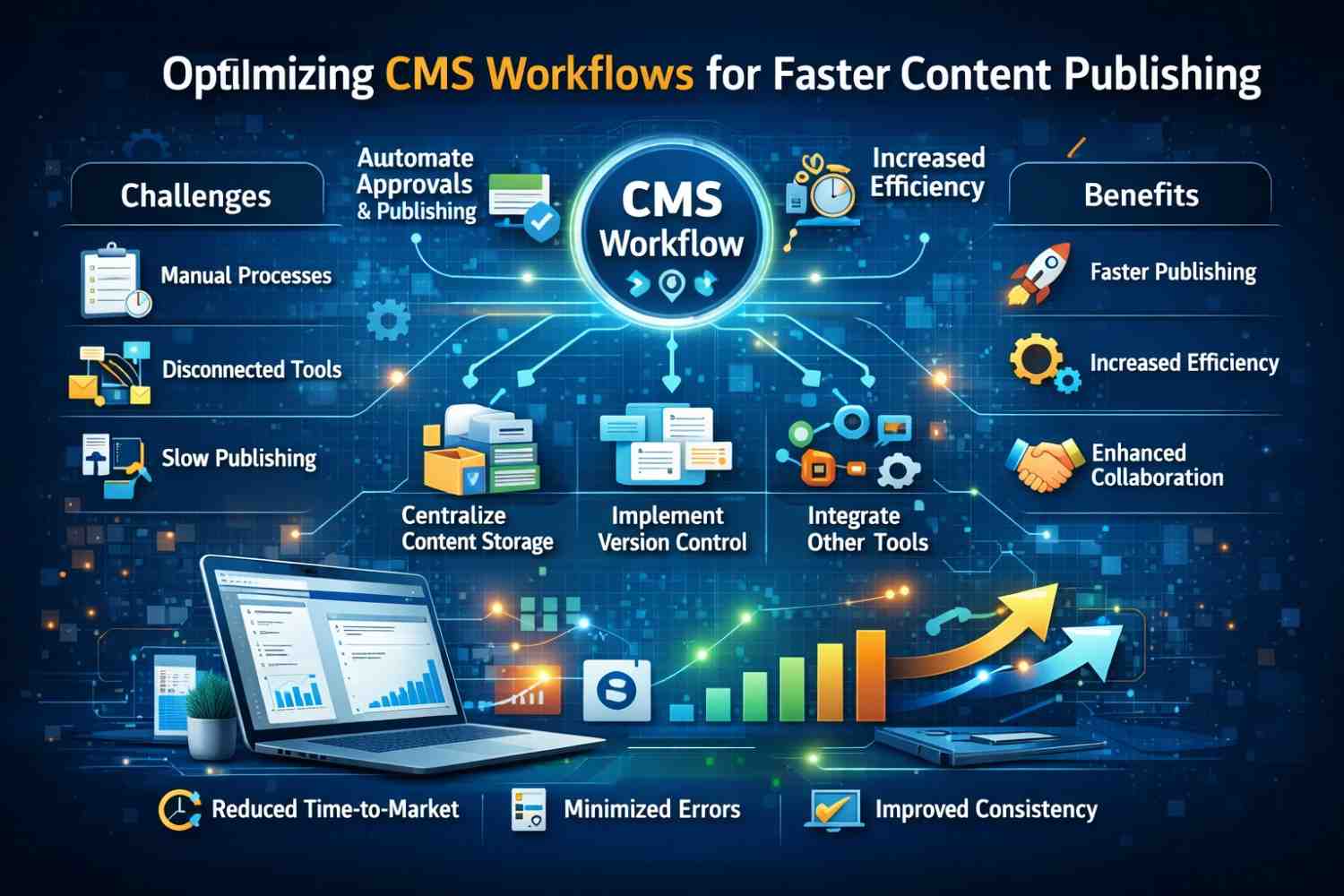
The traditional content management process often involves manual steps that are time-consuming and prone to human error. These include drafting, editing, approval processes, content migration, and updating multiple content pieces across various platforms. When teams rely on manual or disconnected tools, delays occur, creating bottlenecks in content publishing.
For example, without a streamlined approval process, content may sit in review for days, stalling production timelines. Similarly, if teams work in silos without proper communication, content may be duplicated or even missed. Such inefficiencies lead to poor time management and hinder teams from meeting deadlines.
Another challenge arises when content needs to be distributed across multiple channels. Without automation or integration, content teams often have to manually adjust content formats for websites, social media, or email newsletters. This is repetitive work that adds no value but consumes a significant amount of time and effort.
With the increasing importance of speed in digital marketing and content strategy, these outdated workflows can put organizations at a competitive disadvantage. Therefore, optimizing CMS workflows is essential for businesses to stay agile, reduce operational overhead, and publish content faster.
Objective
The goal of optimizing CMS workflows is to create a system that supports rapid content creation, efficient approval processes, and seamless content distribution. By doing so, businesses can enhance their content delivery and improve overall operational efficiency.
Moreover, optimizing these workflows will enable content teams to focus on high-value tasks like creating engaging contment, instead of getting bogged down by repetitive administrative tasks. This shift allows businesses to keep up with the constant demand for fresh, relevant content while improving quality.
Implementing an optimized CMS also promotes cross-functional collaboration between marketing, design, and content teams, ensuring that content meets brand guidelines and customer expectations. Ultimately, faster content publishing leads to better customer engagement, higher website traffic, and more successful marketing campaigns.
CMS Workflow Optimization Strategies
Optiizing CMS workflows involves assessing the entire content lifecycle—from creation to approval and final publishing. Below are several strategies for achieving faster content publishing by leveraging modern CMS features.
Automate Content Approvals and Publishing
One of the most time-consuming aspects of content creation is the approval process. Traditional approval workflows often involve emails and manual tracking of changes, which can be cumbersome. By automating approval stages within the CMS, businesses can eliminate delays and reduce administrative burden.
Contentful, for example, offers advanced workflow automation tools that allow businesses to create custom approval processes. By setting rules and triggers, content can automatically move through the stages of review and approval, ensuring that nothing is missed and minimizing manual oversight. A contentful CMS developer can help tailor these workflows based on specific business needs, streamlining the entire approval process.
Additionally, CMS platforms can be integrated with publishing tools, enabling automatic content deployment to multiple channels. This reduces the need for manual intervention when publishing across websites, social media, and email newsletters.
Create a Centralized Content Repository
A centralized content repository helps content teams avoid duplication and ensures that content is consistent across all channels. In a traditional CMS, content is often stored in silos, which can make it difficult for teams to find existing pieces and reuse them. This leads to duplicated efforts and a longer content production cycle.
Modern CMS systems, like Contentful, provide a central content hub where all assets, including text, images, and videos, are stored and organized. This allows teams to quickly access and repurpose existing content for new campaigns. A contentful CMS developer can help configure the repository to optimize content categorization and metadata, making it easier to search for relevant pieces.
Implement Version Control
When content is being edited, it’s important to track changes and maintain a history of versions to avoid errors and confusion. Version control allows teams to roll back to previous iterations of content, ensuring that any mistakes made during editing can be easily corrected.
Many CMS platforms, including Contentful, come with built-in version control, allowing content creators to track every change made to a piece. This reduces the risk of publishing incorrect or incomplete content and enables teams to maintain a smooth workflow.
Integrate CMS with Other Tools
Today’s digital ecosystems require businesses to connect their CMS with other tools and platforms, such as customer relationship management (CRM) software, marketing automation tools, and analytics platforms. Integration eliminates data silos and ensures that content is aligned with marketing strategies.
For example, by integrating a CMS with email marketing tools, content teams can ensure that newsletters and promotional emails are published automatically when new content is created. Similarly, integration with CRM tools allows content to be personalized based on customer data.
By leveraging a contentful CMS developer, businesses can create custom integrations that connect their CMS with third-party tools to streamline their workflow and ensure better alignment between content, marketing, and sales teams.
Improve Content Distribution Channels
Once content is created and approved, it needs to be distributed across multiple channels. Without the proper automation, this process becomes time-consuming and prone to errors. Businesses can optimize this step by utilizing CMS tools that enable multi-channel publishing.
Contentful’s API-based architecture makes it easy to distribute content to various channels like websites, mobile apps, and social media platforms. Custom content models and delivery APIs ensure that content is automatically adjusted to fit the format required for each platform, saving time and reducing errors.
A contentful CMS developer can help ensure that the CMS is integrated with the right distribution channels, optimizing content publishing and improving overall workflow efficiency.
Benefits of CMS Workflow Optimization
Increased Efficiency
By automating repetitive tasks like approvals, content migration, and publishing, CMS workflow optimization enables content teams to work more efficiently. Automation ensures that each step of the process is completed without delays, allowing teams to focus on content creation.
Faster Time-to-Market
With faster approval processes and seamless integration between CMS and other marketing tools, content can be published quickly across various channels. Businesses can respond to trends and market demands faster, keeping their content strategy competitive and relevant.
Enhanced Collaboration
An optimized CMS creates a collaborative environment where marketing, design, and content teams can work together seamlessly. Real-time updates, version control, and integrated tools ensure that everyone is on the same page throughout the content lifecycle.
Consistent Branding
When content is stored in a centralized repository and workflows are automated, businesses can ensure that all content adheres to brand guidelines. This consistency across content pieces and platforms strengthens brand identity and improves customer perception.
Conclusion
Optimizing CMS workflows for faster content publishing is crucial in today’s competitive digital landscape. By automating key processes like approvals, publishing, and content distribution, businesses can reduce delays, improve content quality, and increase overall efficiency.
Using platforms like Contentful, businesses can leverage flexible workflows, integration with other tools, and centralized content management to streamline the entire process. Whether you’re working on a large-scale website, marketing campaign, or social media presence, a contentful CMS developer can help tailor the CMS to meet your specific needs, ensuring faster time-to-market and more effective content delivery.
Ultimately, the key to optimizing CMS workflows lies in leveraging the right technology, automation, and integration. This results in faster content publishing, better collaboration, and more agile content management, all of which are essential for maintaining a strong digital presence and staying competitive in the marketplace



Leave a Reply