
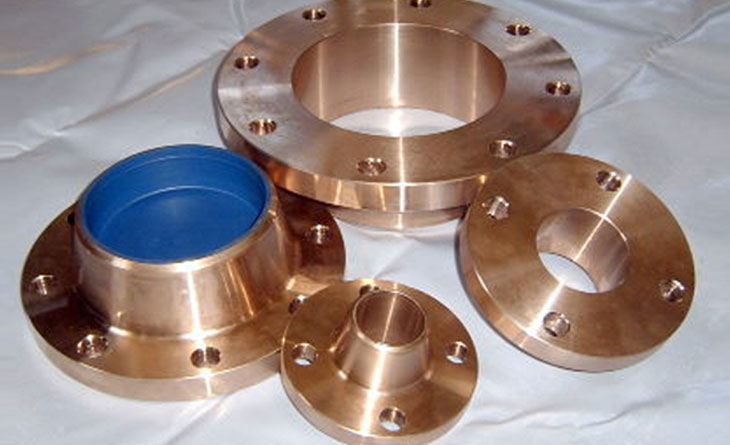
Copper flanges are widely used in industrial piping systems to connect pipes, valves, pumps, and other equipment. These flanges create secure joints that help maintain efficient fluid flow while allowing easy installation and maintenance. Because copper offers excellent corrosion resistance, durability, and thermal conductivity, copper flanges are commonly used in industries such as plumbing, HVAC, chemical processing, and heat exchanger systems.
Weld Neck Copper Flanges
Weld neck copper flanges are designed with a long tapered hub that is welded directly to the pipe. This design helps distribute stress evenly across the connection and provides excellent strength. Weld neck copper flanges are commonly used in high-pressure and high-temperature piping systems where strong and reliable connections are required.
Slip-On Copper Flanges
Slip-on copper flanges are designed to slide over the pipe before being welded in place. They are easy to install and align, making them a popular choice for many piping systems. Slip-on flanges are typically used in low to moderate pressure applications such as water pipelines, cooling systems, and general industrial piping.
Blind Copper Flanges
Blind copper flanges are used to close the end of a pipeline or pressure vessel. Since these flanges do not have a central opening, they completely stop the flow of fluid. Blind flanges are often used during maintenance, inspection, or when a pipeline needs to be sealed temporarily.
Threaded Copper Flanges
Threaded copper flanges contain internal threads that allow them to be attached to threaded pipes without welding. These flanges are commonly used in small piping systems where welding is not practical or where easy removal of the connection is required.
Socket Weld Copper Flanges
Socket weld copper flanges are designed for small-diameter pipes operating under high pressure. The pipe is inserted into a recessed socket and then welded to create a strong and leak-resistant connection. These flanges are widely used in industrial systems where reliability and strength are important.
Lap Joint Copper Flanges
Lap joint copper flanges are used with stub ends and can rotate around the pipe. This feature allows easy alignment of bolt holes during installation. Lap joint flanges are often used in systems that require frequent dismantling for maintenance or cleaning.
Industrial Uses of Copper Flanges
Copper flanges are used in various industrial sectors due to their durability and resistance to corrosion. Some common applications include:
-
HVAC and air conditioning systems
-
Plumbing and water supply networks
-
Heat exchanger equipment
-
Chemical and processing industries
-
Marine and shipbuilding systems
These industries rely on copper flanges to maintain reliable piping connections and efficient fluid flow.
Advantages of Copper Flanges
Copper flanges offer several advantages in industrial piping systems. They are highly resistant to corrosion, which increases the lifespan of pipelines and equipment. Copper also has excellent thermal conductivity, making it ideal for heat transfer applications. Additionally, copper flanges are easy to fabricate and install, which helps reduce installation time and maintenance costs.
Conclusion
Copper flanges play an important role in connecting and maintaining piping systems in many industrial applications. With different types such as weld neck, slip-on, blind, threaded, socket weld, and lap joint flanges, they provide flexibility for various piping requirements. Their corrosion resistance, durability, and reliable performance make copper flanges a valuable component in modern industrial piping systems.



Leave a Reply