
Your CAC is too high. You know it. Your investors know it. Every board meeting includes the same slide showing acquisition costs trending in the wrong direction. Most venture-backed startups overpay for customers because they scale spend before fixing fundamentals.
Here are seven strategies to cut acquisition costs dramatically, without cutting growth.
Why CAC Keeps Climbing
The default response to high CAC is to “optimize ads.” But ads are usually the symptom, not the cause. CAC climbs when your targeting is broad, your funnel is leaky, and your channels are saturated.
Most startups try to fix this by tweaking ad copy or adjusting bids. These are surface-level changes. Real CAC reduction requires structural changes to how you acquire and convert customers.
The other issue is measurement. If your attribution is broken, you might be overinvesting in channels that do not work. Fixing measurement often “reduces” CAC overnight because you stop funding dead-end campaigns.
High CAC is not a marketing problem. It is a systems problem. Fix the system, not the symptoms.
Seven Strategies That Actually Work
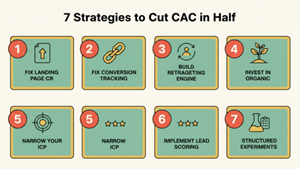
1. Fix Your Landing Page Conversion Rate First
Every percentage point improvement in landing page conversion rate drops your effective CAC by the same percentage. If you are converting at 2% and improve to 4%, your CAC just halved without changing a single ad. A marketing agency for startups will run conversion rate optimization before scaling any paid channel.
Test your headline, CTA, form length, and social proof placement. A 1% conversion rate improvement on a page with 10,000 monthly visitors is 100 more leads per month at zero incremental cost.
2. Implement Proper Conversion Tracking
Stop trusting platform-reported numbers. Compare every ad platform’s conversion data against your CRM weekly. Startups that fix their tracking discover they have been overvaluing certain channels by 30-50%. Reallocating budget to performing channels reduces blended CAC immediately.
3. Build a Retargeting Engine
Retargeting converts at 3-5x the rate of prospecting. Yet most startups spend 80% of their budget on cold traffic. Build segmented retargeting audiences: site visitors, pricing page viewers, trial users who stalled. Each segment gets tailored messaging. This is your lowest-CAC channel.
4. Invest in Organic Channels for Compounding Returns
Paid media has linear economics. You stop spending, you stop getting leads. Organic channels like SEO and content marketing compound. An article published today drives traffic for years. Start building organic now so it carries more weight in 6-12 months.
5. Narrow Your ICP and Cut Waste Audiences
Broad targeting is expensive targeting. Review your last 100 customers. Identify the common attributes: company size, industry, job title. Build campaigns around this tight profile. A narrow ICP means higher CPMs but dramatically higher conversion rates, which nets out to lower CAC.
6. Implement Lead Scoring to Focus Sales Effort
Not every lead deserves a sales call. Build a scoring model based on firmographic fit and behavioral engagement. Route high-score leads to sales immediately. Nurture low-score leads via email. This reduces the sales cost per closed deal, a major component of fully-loaded CAC.
7. Run Structured Experiments, Not Ad Hoc Changes
Random optimizations produce random results. Build a testing framework with clear hypotheses and success criteria. A marketing agency for startups runs weekly experiments with documented learnings that compound over time.
Putting It Together: A 90-Day CAC Reduction Plan
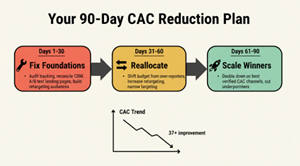
Days 1-30: Fix measurement and conversion fundamentals. Audit tracking. Reconcile platform data with CRM data. Run landing page A/B tests. Build retargeting audiences.
Days 31-60: Reallocate based on real data. Shift budget from channels that over-report. Increase retargeting spend. Narrow targeting on prospecting campaigns.
Days 61-90: Scale what works, cut what does not. Double down on channels with the best CRM-verified CAC. Kill campaigns that cannot meet your target CPA.
The Compound Effect of Lower CAC
Startups that cut their CAC in half do not just save money. They unlock growth. The same budget now produces twice as many customers. Or the same number of customers at half the cost, extending your runway by months.
Companies that systematically reduce CAC report improvements of 37% or more within one quarter. Lower CAC means more customers. More customers means more data. More data means better targeting. The compounding effect is powerful.
Your competitors who fixed their acquisition economics early are growing faster on the same budget because every dollar works harder. The gap between a $300 CAC and a $150 CAC is the difference between a startup that scales and one that stalls.
Fix the system. The math will follow.





Leave a Reply