
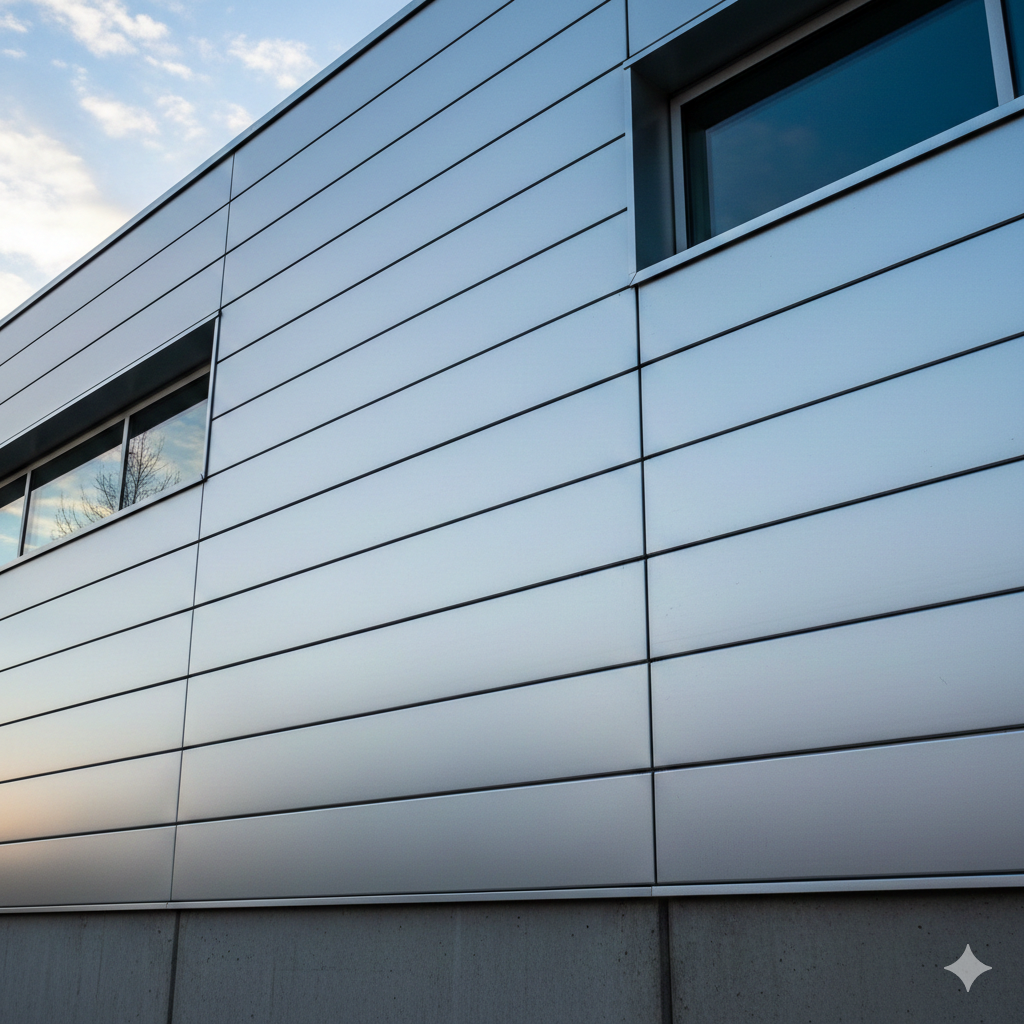
You can think of metal composite material as a engineered blend that pairs metal skins or matrices with reinforcing components to give you greater strength, lighter weight, and better wear or thermal performance than many conventional metals. Metal matrix and metal-clad composites let you choose combinations — like aluminum with ceramic particles or metal faces with a polymer core — to match stiffness, corrosion resistance, and aesthetics to your project’s needs.
This article will walk you through the key properties and common types, then show how manufacturers make and apply these materials across aerospace, automotive, construction, electronics, and more so you can judge which options meet your performance and cost targets.
Properties and Types of Metal Composite Material
You will find combinations of metallic skins and engineered cores tailored to strength, weight, thermal behavior, and fire performance. The subsections below explain common core and skin choices, key physical and mechanical metrics, and how these materials behave under fire and long-term exposure.
Core Materials and Metal Skins
Core choices determine weight, stiffness, and thermal insulation. Common cores include polymeric honeycomb (Nomex, aramid) for very low weight and good compressive strength; aluminum honeycomb for higher shear strength and thermal conduction; and mineral or foam cores (thermally stable polyisocyanurate, mineral wool, or phenolic foam) when fire resistance matters. You should pick cores based on required compressive strength (kN/m²), density (kg/m³), and operating temperature.
Metal skins typically use aluminum alloys (e.g., 3003, 5052, 6061) for corrosion resistance and low weight, steel (galvanized or stainless) for impact and rigidity, or titanium where high strength-to-weight and temperature resistance are essential. Skin thickness usually ranges from 0.2 mm to 3 mm depending on load and forming demands. Bonding method—adhesive, diffusion bonding, or mechanical fastening—affects fatigue performance and repairability, so specify adhesive type and cure cycle when you design.
Physical and Mechanical Properties
Focus on density, stiffness, strength, and thermal expansion for application fit. Metal composites can reduce density by 30–70% versus monolithic metals, depending on core choice; expect typical sandwich panel densities from 2.0 to 8.0 kg/m² for lightweight aerospace panels up to heavier structural panels above 20 kg/m². Bending stiffness scales with the cube of panel thickness, so thin skins over a thick core deliver high flexural rigidity with low mass.
Key mechanical metrics to check: tensile strength and yield of skins, core shear strength (kPa–MPa), core compressive strength, and panel flatwise tensile strength. Thermal expansion mismatch between skins and core can induce residual stresses; use similar coefficients of thermal expansion (CTE) or design compliant joints. Fatigue life depends on bond quality and local stress concentrations; specify peel and shear test values during procurement.
Fire Resistance and Durability
You must evaluate both fire performance and long-term environmental durability separately. Fire-rated cores—mineral wool and phenolic foams—offer limited smoke and low heat release; polymeric honeycombs fail by charring or collapse unless intumescent-treated. Metal skins resist ignition, but panel integrity depends on core behavior and adhesive stability at elevated temperatures. Request standardized fire test results (e.g., ASTM E84, EN 13501) for your intended application.
For durability, consider corrosion protection on skins (anodizing, galvanic coatings) and moisture ingress protection at edges and joints. Water ingress can degrade polymer cores and adhesives, reducing shear and peel strength; specify edge sealing and drainage. Also check UV stability for exposed applications and cyclic thermal/humidity test data for long-term performance.
Applications and Manufacturing Methods
Metal composite materials deliver targeted combinations of strength, weight savings, wear resistance, and thermal stability for structural, transport, and industrial uses. You will find specific applications in building facades and load-bearing elements, vehicle components and brake systems, and a range of production processes from powder metallurgy to stir casting and squeeze casting.
Architectural Uses
You can use metal composites for cladding, curtain walls, and load-bearing panels where reduced weight and corrosion resistance matter. Aluminum matrix composites with ceramic reinforcements resist weathering and maintain flatness on large façades, reducing support framing and installation time.
In structural elements, fiber- or particulate-reinforced composites increase stiffness without the weight penalty of solid steel. You should specify compositions that balance thermal expansion with adjacent materials to avoid joint stress. For interior applications, choose composites with coatings that meet fire and indoor air-quality standards.
Key benefits at a glance:
- Lightweight cladding: lower dead load and foundation costs.
- Durability: abrasion and corrosion resistance for coastal or industrial environments.
- Thermal control: tailored coefficients of thermal expansion for glazing and frames.
Transportation and Automotive Applications
You will find metal composites in engine components, brake rotors, pistons, and structural subframes where wear resistance and specific strength are critical. Silicon-carbide reinforced aluminum alloys reduce weight in engine blocks while improving thermal conductivity and wear life.
For braking and high-friction parts, MMCs with ceramic particulates extend service intervals and resist thermal distortion. In chassis and body elements, hybrid laminates and metal matrix laminates let you tune stiffness and crash behavior while lowering mass for better fuel economy or range in EVs.
Typical selection criteria you should use:
- Wear resistance: ceramic particulates for long-life contact surfaces.
- Thermal stability: low expansion and high conductivity for engines and brakes.
- Manufacturability: ability to cast, machine, or join without excessive tool wear.
Production Processes
Choose a manufacturing route based on part complexity, cost, and volume requirements. Common processes include:
- Stir casting: simple and low-cost; you can disperse particulates into molten metal for large-volume components.
- Powder metallurgy: precise composition control and near-net shapes; ideal for small to medium, high-performance parts.
- Squeeze casting and infiltration: produce dense parts with good matrix–reinforcement bonding, suitable for structural components.
Consider secondary processing and surface treatments. Machining abrasive-reinforced MMCs requires carbide or diamond tooling and coolant control. Joining methods include mechanical fastening, adhesive bonding, and specialized welding or brazing protocols; you should validate joint designs to prevent galvanic corrosion.
Process selection checklist:
- Volume and unit cost targets
- Required microstructure and mechanical properties
- Tooling and post-processing capabilities






Leave a Reply