
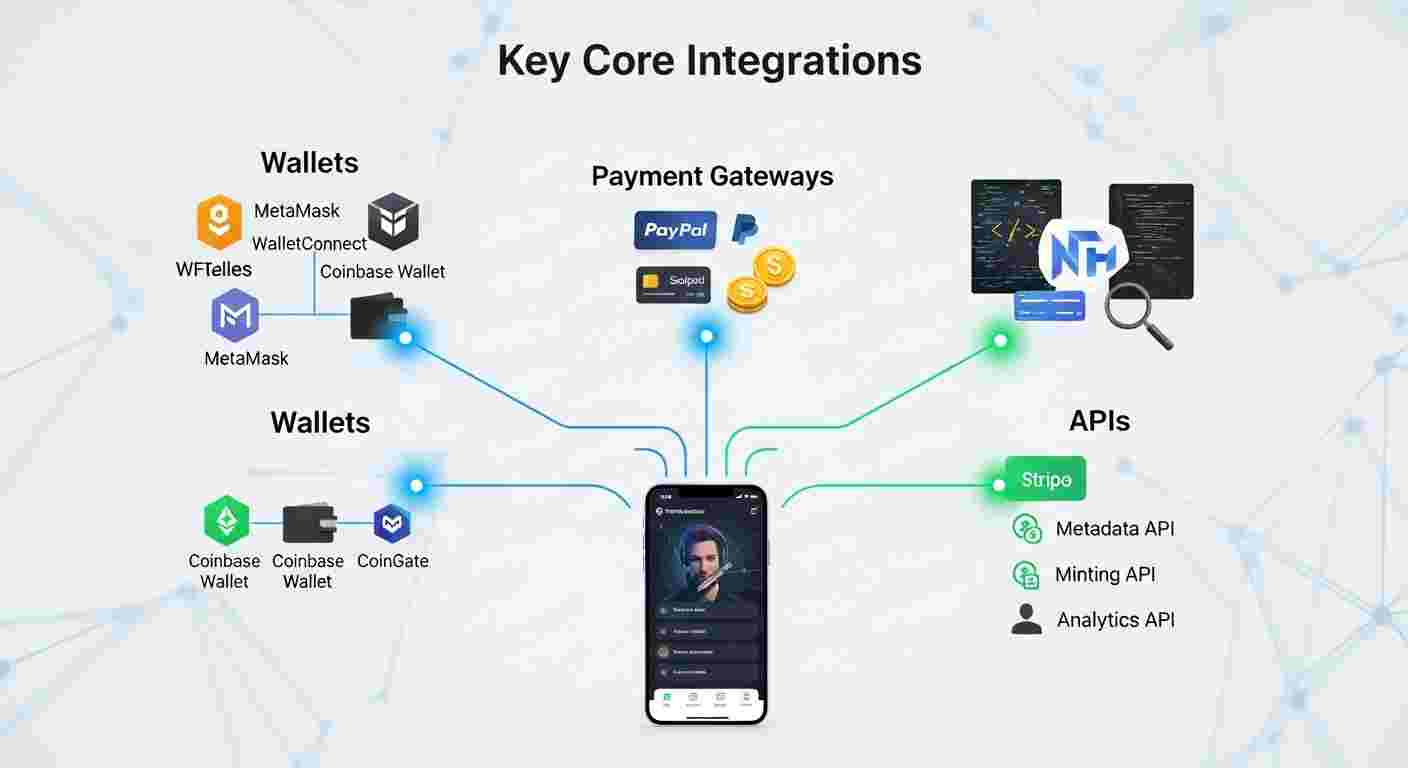
Launching an NFT marketplace involves far more than simply listing digital collectibles. Behind every successful platform is a network of integrated technologies that make trading, minting, payments, and user management possible.
Some of the most critical integrations include:
-
Secure blockchain wallet connectivity
-
Reliable payment gateways for fiat and crypto
-
APIs that connect services and automate processes
-
Smart contract frameworks for minting and royalties
-
Data systems that power marketplace operations
These integrations form the technical backbone of platforms created by a White Label NFT Marketplace Development Company. By combining ready-made infrastructure with customized features, businesses can launch secure and scalable NFT marketplaces much faster than building everything from scratch.
This article explores the most important technical integrations used in modern NFT platforms and how White Label NFT Marketplace Solutions simplify the process of building a fully functional digital asset marketplace.
Understanding the Role of Integrations in NFT Marketplaces
Technical integrations determine how smoothly a marketplace functions. From user authentication to asset transfers, every transaction depends on a reliable connection between blockchain networks and platform services.
A White Label NFT Marketplace Development Company typically incorporates multiple integrations during development to ensure the marketplace can handle real-world trading activities.
Important integration roles include:
Connecting Users to Blockchain Networks
NFT transactions occur on blockchain networks, which means the platform must provide seamless access to those networks. Integrations allow users to interact with the blockchain without needing advanced technical knowledge.
Enabling Digital Asset Ownership
Ownership verification is essential in NFT ecosystems. Integrations with blockchain nodes and smart contracts ensure that asset ownership records remain transparent and tamper-proof.
Supporting Marketplace Operations
Core marketplace activities such as minting, bidding, purchasing, and transferring NFTs require continuous interaction between multiple systems. APIs and backend services manage these interactions efficiently.
Ensuring Secure Transactions
Security integrations protect user funds, private keys, and transaction records. Encryption, wallet authentication, and blockchain verification systems work together to maintain trust.
White Label NFT Marketplace Service Providers design these integrations so businesses can focus on platform growth rather than technical infrastructure.
Wallet Integrations: The Foundation of NFT Ownership
Digital wallets play a critical role in NFT ecosystems. They store private keys, manage digital assets, and allow users to interact with blockchain networks.
Without wallet integrations, users would not be able to mint, purchase, or sell NFTs.
A White Label NFT Marketplace Development Company typically integrates multiple wallet options to ensure accessibility and convenience for users worldwide.
Types of Wallet Integrations
Different users prefer different wallet types. NFT marketplaces must therefore support several options.
Web Wallets
Web wallets allow users to access their NFTs directly through the platform interface.
Key advantages include:
-
Easy access without external applications
-
Simplified user onboarding
-
Seamless transaction approval
These wallets are commonly integrated into White Label NFT Marketplace Development frameworks to simplify the user experience.
Mobile Wallets
Mobile wallets enable users to manage NFTs through smartphone applications.
Benefits include:
-
Portable access to digital assets
-
Secure QR code authentication
-
Compatibility with decentralized applications
Many modern NFT platforms connect mobile wallets through deep linking or QR code scanning.
Browser Wallet Extensions
Browser extensions remain one of the most widely used wallet solutions.
They allow users to connect their wallets instantly to NFT marketplaces through secure authentication.
Features include:
-
Transaction signing within the browser
-
Instant marketplace access
-
Integration with decentralized applications
Multi-Wallet Support
A single wallet option is rarely enough. Platforms developed through White Label NFT Marketplace Solutions usually support multiple wallets to ensure wider adoption.
Advantages include:
-
Increased user flexibility
-
Higher transaction volume
-
Greater accessibility for global audiences
Wallet integration is therefore a foundational feature of any modern NFT marketplace.
Payment Gateway Integrations in NFT Marketplaces
While cryptocurrency remains the primary payment method for NFTs, many platforms now support fiat payments as well. This requires integration with reliable payment gateways.
A White Label NFT Marketplace Development Company typically implements both crypto and fiat payment solutions to expand the platform’s reach.
Cryptocurrency Payment Systems
Crypto payments allow users to purchase NFTs using digital currencies.
These systems enable:
-
Direct blockchain transactions
-
Instant NFT transfers
-
Transparent payment records
Popular cryptocurrencies supported by NFT marketplaces include Ethereum, Polygon tokens, and other blockchain-native assets.
Benefits of Crypto Payments
Crypto payment integrations provide several advantages.
-
Decentralized transaction processing
-
Lower international transaction barriers
-
Faster settlement times
White Label NFT Marketplace Service Providers design payment modules that automatically verify transactions on the blockchain.
Fiat Payment Integrations
Many users prefer purchasing NFTs with traditional payment methods such as credit cards or bank transfers.
Fiat payment gateways enable these transactions by converting currency into cryptocurrency during the purchase process.
Benefits include:
-
Easier onboarding for new users
-
Wider global adoption
-
Simplified NFT purchases for non-crypto users
These integrations help NFT platforms attract audiences beyond the cryptocurrency community.
Hybrid Payment Systems
Some marketplaces combine both fiat and crypto payment methods.
This hybrid approach offers several benefits.
-
Flexibility for buyers and sellers
-
Increased marketplace liquidity
-
Higher user engagement
White Label NFT Marketplace Solutions often include hybrid payment modules to support multiple transaction methods.
API Integrations: The Backbone of Platform Functionality
Application Programming Interfaces (APIs) allow different software systems to communicate with each other. In NFT marketplaces, APIs connect blockchain services, payment systems, user dashboards, and analytics platforms.
Without APIs, many marketplace features would not function efficiently.
A White Label NFT Marketplace Development Company typically uses APIs to simplify development and improve platform scalability.
Blockchain APIs
Blockchain APIs allow the marketplace to interact with blockchain networks.
Key functions include:
-
Retrieving transaction data
-
Verifying NFT ownership
-
Monitoring wallet balances
-
Broadcasting transactions
These APIs ensure that NFT transactions occur accurately and transparently.
Marketplace APIs
Marketplace APIs manage the internal operations of the platform.
They handle processes such as:
-
NFT listings
-
Auction management
-
bidding activity
-
user account management
By connecting backend systems with the user interface, APIs ensure that marketplace actions happen instantly.
Payment APIs
Payment gateways also rely on APIs to process transactions.
Payment APIs enable:
-
Real-time payment verification
-
automated currency conversion
-
secure transaction authorization
These integrations ensure smooth and reliable NFT purchases.
Analytics APIs
Understanding user behavior is essential for marketplace growth.
Analytics APIs provide insights such as:
-
NFT trading trends
-
user activity patterns
-
transaction volumes
White Label NFT Marketplace Service Providers often integrate analytics tools so businesses can monitor marketplace performance and make strategic decisions.
Smart Contract Integrations
Smart contracts play a central role in NFT marketplaces. These blockchain programs automatically execute transactions when predefined conditions are met.
A White Label NFT Marketplace Development Company integrates smart contracts to manage digital asset ownership and automate marketplace activities.
NFT Minting Contracts
Minting contracts create NFTs on the blockchain.
These contracts define:
-
NFT metadata
-
ownership records
-
asset identifiers
Once deployed, the contract permanently records NFT creation on the blockchain.
Royalty Contracts
NFT creators often receive royalties when their assets are resold.
Royalty contracts automatically distribute a percentage of each resale transaction to the original creator.
Benefits include:
-
fair compensation for artists
-
automated payment distribution
-
transparent royalty tracking
Royalty automation is a key feature included in many White Label NFT Marketplace Development platforms.
Auction Contracts
Auction contracts manage bidding processes.
They handle functions such as:
-
starting and ending auctions
-
tracking bids
-
transferring ownership to the highest bidder
These contracts ensure fair and transparent auction operations.
Security Integrations for NFT Marketplaces
Security is one of the most critical considerations in NFT platform development. A secure marketplace protects both user assets and platform infrastructure.
White Label NFT Marketplace Service Providers incorporate multiple security layers into their solutions.
Wallet Authentication
Secure wallet authentication ensures that only authorized users can access digital assets.
Common methods include:
-
cryptographic signature verification
-
two-factor authentication
-
biometric security options
These measures prevent unauthorized transactions.
Smart Contract Audits
Smart contract vulnerabilities can lead to serious financial losses.
To prevent this, development companies conduct extensive security audits before deploying smart contracts.
Audits verify:
-
contract logic accuracy
-
vulnerability protection
-
transaction integrity
Data Encryption
Sensitive user data must be protected using encryption technologies.
Encryption safeguards:
-
wallet addresses
-
transaction details
-
personal information
White Label NFT Marketplace Development solutions include encryption protocols that protect user privacy and platform data.
Cross-Chain Integration for NFT Marketplaces
As blockchain ecosystems continue to expand, many NFT platforms now support multiple networks.
Cross-chain integration allows NFTs to be traded across different blockchains.
Advantages include:
-
wider asset compatibility
-
access to multiple blockchain communities
-
improved marketplace liquidity
A White Label NFT Marketplace Development Company can integrate multi-chain functionality so users can trade NFTs from different networks within a single platform.
Content Delivery and Storage Integrations
NFTs often include images, videos, audio files, and other digital assets. These files must be stored and delivered efficiently.
To achieve this, marketplaces integrate decentralized storage systems.
Common storage solutions include:
-
IPFS distributed storage networks
-
decentralized file hosting services
-
secure cloud infrastructure
These integrations ensure that NFT content remains accessible even if the original platform changes or evolves.
User Experience Integrations
Beyond core blockchain functionality, successful NFT marketplaces focus heavily on user experience.
A White Label NFT Marketplace Development Company typically integrates tools that improve usability and engagement.
Examples include:
-
intuitive dashboards for NFT management
-
notification systems for bids and sales
-
advanced search and filtering features
-
portfolio tracking tools
These features help users navigate the marketplace easily and encourage continued participation.
Scalability Integrations for Growing NFT Platforms
As marketplaces grow, they must support increasing transaction volumes and user activity.
Scalable architecture is therefore essential.
White Label NFT Marketplace Solutions often incorporate scalable technologies such as:
-
microservices architecture
-
cloud-based infrastructure
-
load balancing systems
-
blockchain layer-2 scaling solutions
These technologies ensure that the marketplace remains fast and responsive even during high trading activity.
Business Advantages of White Label Integration Solutions
Businesses launching NFT platforms often face complex technical challenges. Integrations involving blockchain networks, wallets, payment systems, and APIs require significant development expertise.
Working with a White Label NFT Marketplace Development Company provides several advantages.
Faster Platform Deployment
Pre-integrated technologies allow businesses to launch NFT marketplaces much faster than building custom infrastructure.
Reduced Development Costs
Ready-made integration frameworks reduce the need for extensive custom development.
Proven Technology Infrastructure
White Label NFT Marketplace Service Providers typically use tested and audited systems that minimize technical risks.
Flexible Customization
Although the core platform is prebuilt, businesses can still customize features, branding, and marketplace structure.
These benefits make white label development an attractive option for companies entering the NFT industry.
The Future of NFT Marketplace Integrations
The NFT ecosystem continues to evolve rapidly. As blockchain technology advances, new integrations will further enhance marketplace functionality.
Emerging trends include:
-
AI-powered NFT recommendations
-
decentralized identity verification systems
-
metaverse asset integrations
-
advanced cross-chain interoperability
White Label NFT Marketplace Development frameworks will continue adapting to these trends, enabling businesses to launch platforms that remain competitive in a rapidly changing digital economy.
Conclusion
NFT marketplaces rely on a complex ecosystem of technical integrations. Wallet connectivity, payment gateways, APIs, smart contracts, and security frameworks work together to power every transaction and user interaction.
A White Label NFT Marketplace Development Company simplifies this complexity by providing pre-integrated infrastructure that supports secure, scalable, and feature-rich NFT platforms. Through White Label NFT Marketplace Solutions, businesses can launch marketplaces equipped with wallet support, multi-payment systems, blockchain connectivity, and advanced API frameworks.
With the help of experienced White Label NFT Marketplace Service Providers, companies can focus on building vibrant digital asset ecosystems while relying on proven technology to manage the underlying infrastructure.
As NFTs continue expanding across industries such as gaming, digital art, entertainment, and the metaverse, strong technical integrations will remain the foundation of successful NFT marketplaces.



Leave a Reply